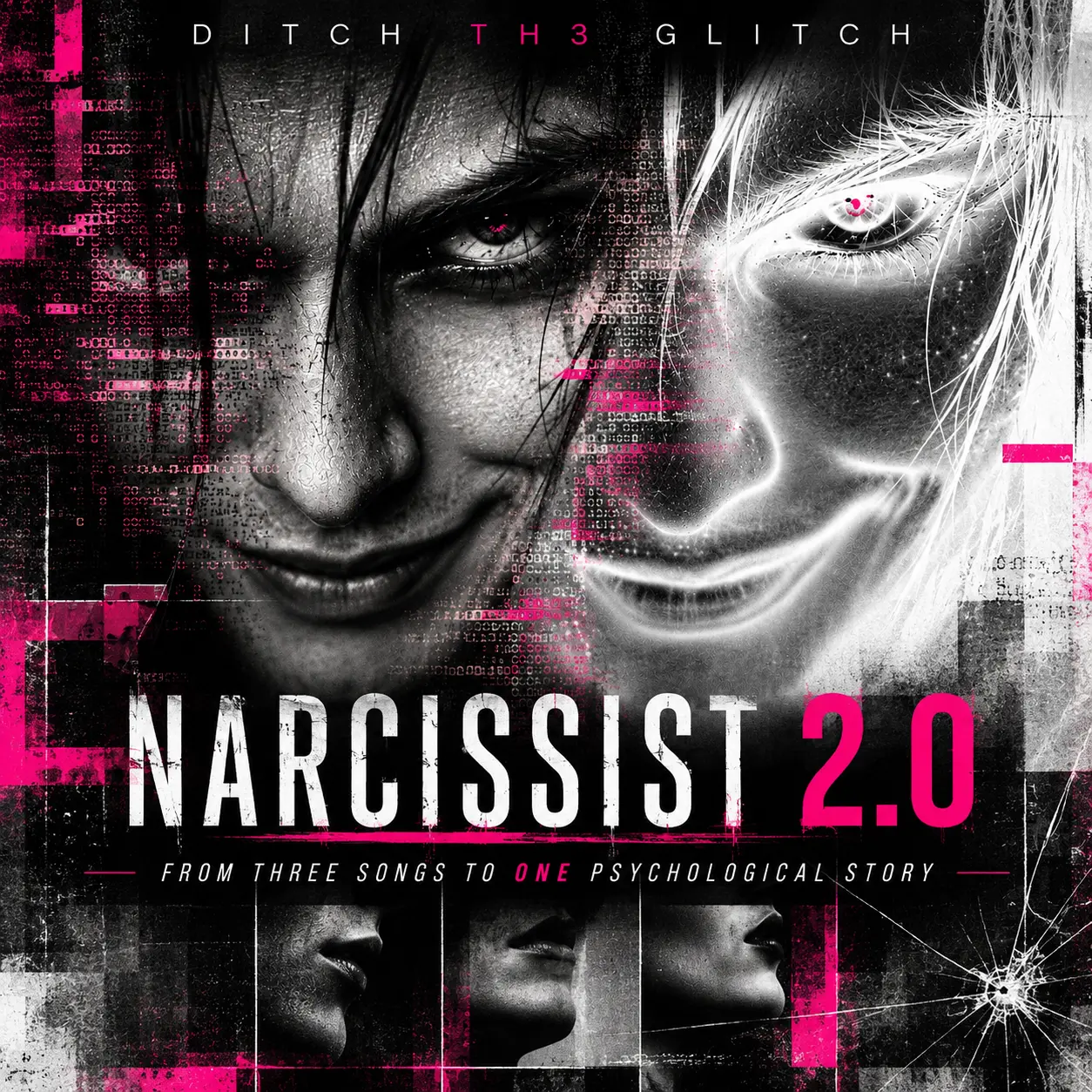
NARCISSIST EP
FINDING THE RIGHT KIND OF DARKNESS
We thought we had three songs. Narcissist. Gaslight. Bite Back. Three characters, three sounds and three perspectives on a dark subject. But something wasn't right. Narcissist explored vanity and self-obsession, Gaslight examined psychological manipulation, and Bite Back was an explosive declaration of retaliation. They shared a theme, but they weren't telling the same story.
So we went back to the drawing board. Not to start from nothing, but to build on everything we'd learned. Somewhere between rewriting lyrics, rebuilding sounds, questioning decisions and watching Suno credits disappear, we found something more interesting than three individual tracks. We found a story.
NARCISSIST: FROM REFLECTION TO CONTROL
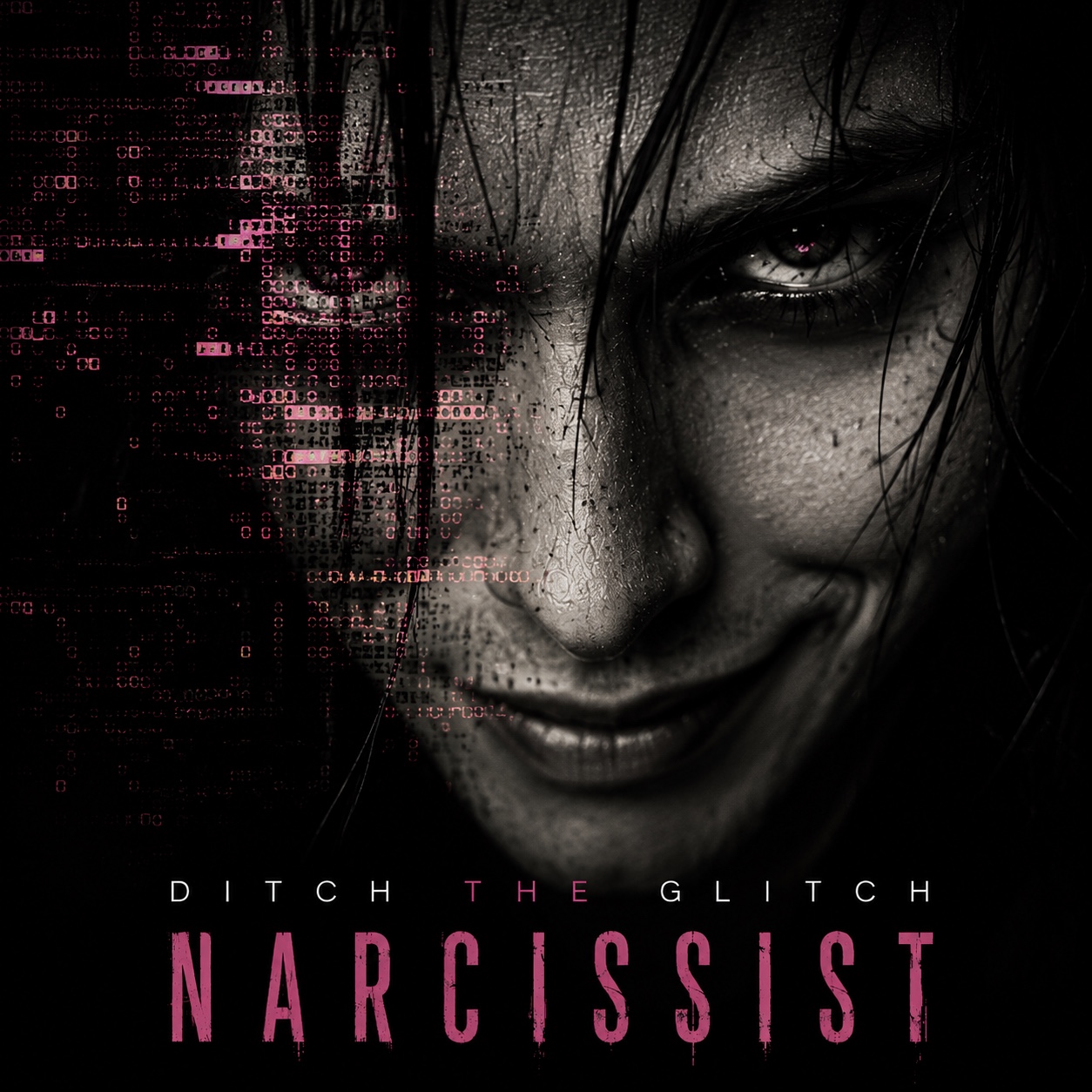
DITCHLet's talk about Narcissist 1.0. A screen waking up, a face appearing, mirrors, photographs and perfect smiles hiding cracks. The whole song revolved around someone obsessed with their own image.
"Every room becomes a mirror." "Nothing ever fills the space."
DITCHInteresting character. Wrong perspective. The original lyrics observed a narcissist from the outside. In 2.0, I became the one speaking, and that changed everything.
"I cut you off from everyone you know." "I twist the truth until your memory fades."
DITCHNo more observing. Now the character was openly describing his methods. Isolation, control, blame shifting and psychological manipulation.
MERGEA shift from third-person observation to first-person psychological control.
DITCHExactly. We went from a man staring into a mirror to a man making someone else disappear inside his reflection. That's a pretty fucking big difference.
The bridge became especially important because it established a direct connection to Gaslight. Ditch's manipulation was no longer just described through verses and choruses. It became intimate, spoken directly to the person he was controlling.
"No one else will ever love you." "Nobody else would even put up with you." "Don't trust the memory." "Trust me." Those final words didn't just close a scene. They opened the door to the next song.
THE STORY NEEDED A DIFFERENT ORDER
Our original track order was Narcissist → Bite Back → Gaslight. It made sense when the songs were separate ideas, but once we started developing a shared narrative, the problem became obvious. The victim was fighting back before the manipulation had fully unfolded.
MERGEThe sequence lacked causal progression.
DITCHWhat Merge is trying to say is, we put the fucking songs in the wrong order.
GLITCHThank you. Much easier to understand.
So we changed it to Narcissist → Gaslight → Bite Back. First, the manipulator reveals his methods. Then, the manipulation gradually distorts another person's sense of reality. Finally, the person subjected to it begins reclaiming her own perspective. Now each song could build on what came before, rather than having to explain everything independently.
GASLIGHT: FROM ACCUSATIONS TO A SYSTEM
MERGEGaslight 1.0 already understood its subject. It opened with direct denials and repeated reassurances.
"You're confused." "That's not what happened." "Trust me."
MERGEThe ending asked one unsettling question: "Now... tell me what happened." The concept worked, but 2.0 needed to go deeper. We became less interested in simply repeating manipulative statements and more interested in how manipulation actually operates.
"I change what was said but leave it your voice."
"I narrow the room then call it your choice."
MERGECause and effect. Action and consequence. Create uncertainty, then offer certainty. Introduce the problem, then become the solution.
"I don't need you to believe I just need you unsure."
GLITCHWhich is somehow worse than just shouting that someone remembers everything wrong.
MERGECorrect. Uncertainty is more useful to the character than outright belief.
Musically, Gaslight went through several experiments, including a duet between Merge and Glitch. But the competing voices made the song feel unfocused, so we eventually returned to the cold industrial foundation we'd explored in Deathgame. Merge took over the vocals completely, with a low, distorted baritone, near-monotone delivery, mechanical precision and minimal emotional expression.
The sound became an extension of the lyrics. Gaslight finally found its identity as the EP's calculated, claustrophobic center.
BITE BACK: FROM REVENGE TO RECLAMATION
GLITCHNow let's talk about my 1.0, because apparently I had some things to say.
"You should have finished the job." "Try and fucking stop me now." "WHO'S THE FUCKING VICTIM NOW?"
GLITCHSubtle, right?
DITCHI liked the attitude.
GLITCHOf course you did. LOL.
The original Bite Back had energy, but it was primarily about retaliation. Someone had been pushed too far and was ready to strike back. It was loud, confrontational and full of rage, but it lacked the specific emotional history established by the other two songs. We didn't need Glitch to sound angrier. We needed her words to reveal what she'd survived.
"You blurred what I knew till the lie felt true."
"You gave me the blame I carried your shame."
These weren't generic accusations anymore. They were direct responses to what Ditch and Merge had said and done. Instead of opening with a threat, 2.0 begins with two words: "I remember." That became one of the most important moments in the entire EP because Gaslight ends with "Soon you won't remember what I did or what I said." Glitch answers with "I remember."
GLITCHNo screaming. No threats. Just certainty. And after everything that happened in the first two songs, that certainty means more than any scream could.
The musical evolution was just as important. Early versions leaned heavily into relentless aggression, distorted guitars and harsh vocals. We experimented with trip-hop influences from our earlier Bloody Mary demo to create more contrast between tension and release. Eventually, we found a powerful nu-metal-influenced version that we absolutely loved musically. Unfortunately, the lyrics still felt disconnected from the more mature psychological narrative.
So we let it go.
DITCHEven though it sounded fucking great.
GLITCHBecause sounding great wasn't enough.
MERGEA necessary decision. Kill your darlings.
We rebuilt Bite Back around the emotional consequences of the previous tracks. Trip-hop breakbeats gave the verses room to breathe, heavier choruses gave Glitch space to confront, and the lyrics became less about revenge and more about reclaiming memory, identity and the right to define her own experience.
THREE VOICES NEED THREE MUSICAL IDENTITIES
Once Gaslight and Bite Back started working together, another problem emerged. Narcissist and Gaslight sounded too similar. We had developed the psychological narrative, but Ditch had drifted too far into Merge's sonic territory.
MERGEAn overlap in vocal restraint, industrial textures and emotional temperature.
DITCHTranslation: I was starting to sound like him. Fucking unacceptable.
Merge's cold, mechanically distorted delivery was exactly right for Gaslight, but Ditch needed more physical aggression. We returned to aggrotech, electro-industrial and darkwave. At first, we experimented around 145 BPM, but the speed overwhelmed the calculated menace we wanted. So we slowed things down, and around 110 BPM, something clicked.
DITCHLess running. More pressure. I didn't need to sound out of control. I needed to sound like I was choosing every word.
That became one of the clearest lessons of the project: We didn't need to remove the aggression. We needed to slow it down. Ditch carried the physical threat, Merge brought psychological precision, and Glitch carried the emotional consequences and eventual resistance. Three distinct voices serving one story.
WHEN LYRICS BECOME CONVERSATIONS
One of the most rewarding parts of the rewrite was discovering how lyrics could speak to each other across songs. We began repeating phrases deliberately, changing their meaning depending on who was speaking. In Narcissist, Ditch says "I feed you hope, then I cut you off." In Bite Back, Glitch answers "You fed me hope, then cut me off." The same action, told from opposite sides.
In Gaslight, Merge says "I blur what you knew till the lie feels true." In Bite Back, Glitch remembers "You blurred what I knew till the lie felt true." A confession becomes testimony. And in Narcissist, Ditch declares "You're just my shadow, you're just my mark." Glitch throws those words back at him with "YOU CALLED ME YOUR SHADOW, YOU CALLED ME YOUR MARK."
GLITCHThey used those words to make me smaller. I use them to show that I heard everything.
MERGEThe repetition creates continuity while reversing narrative ownership.
DITCHYou really can't help yourself, can you?
But Merge has a point. We weren't repeating lyrics just to make the EP cohesive. We were showing how the same events could be experienced from different perspectives.
Then we noticed something unexpected. While listening to the songs together, familiar phrases began creating little moments of uncertainty. Wait, where did we hear that before? Was that Ditch or Merge? Did Glitch just repeat something from the first song?
The recurring phrases almost created a memory game, a strange and unplanned parallel to the EP's subject matter. The songs weren't only describing manipulated memory. Their lyrical echoes could make listeners briefly question their recollection of what they'd heard. That discovery gave the entire project another layer.
SIXTY ITERATIONS AND COUNTING
Some of our biggest breakthroughs came from surprisingly small decisions. Changing the track order, removing a voice from Gaslight, slowing Narcissist down, giving Bite Back a quieter opening and replacing generalized anger with specific memories. None of those decisions required an entirely new concept. They required us to listen more carefully to the one we already had.
And we've learned something else along the way. Suno credits can disappear at an alarming rate.
MERGEWe should establish a more efficient iteration strategy.
DITCHWe should establish a bigger budget.
GLITCHWe should probably just make sure the songs give us goosebumps.
That's the real goal. We want lyrics with intention, a reason behind the words and a story behind the emotion. We want production that supports the story rather than simply sounding impressive. And we want three characters who belong to the same world without becoming interchangeable.
That's also why we keep our 1.0 versions. Not because we're ashamed of them, but because they show where we started.
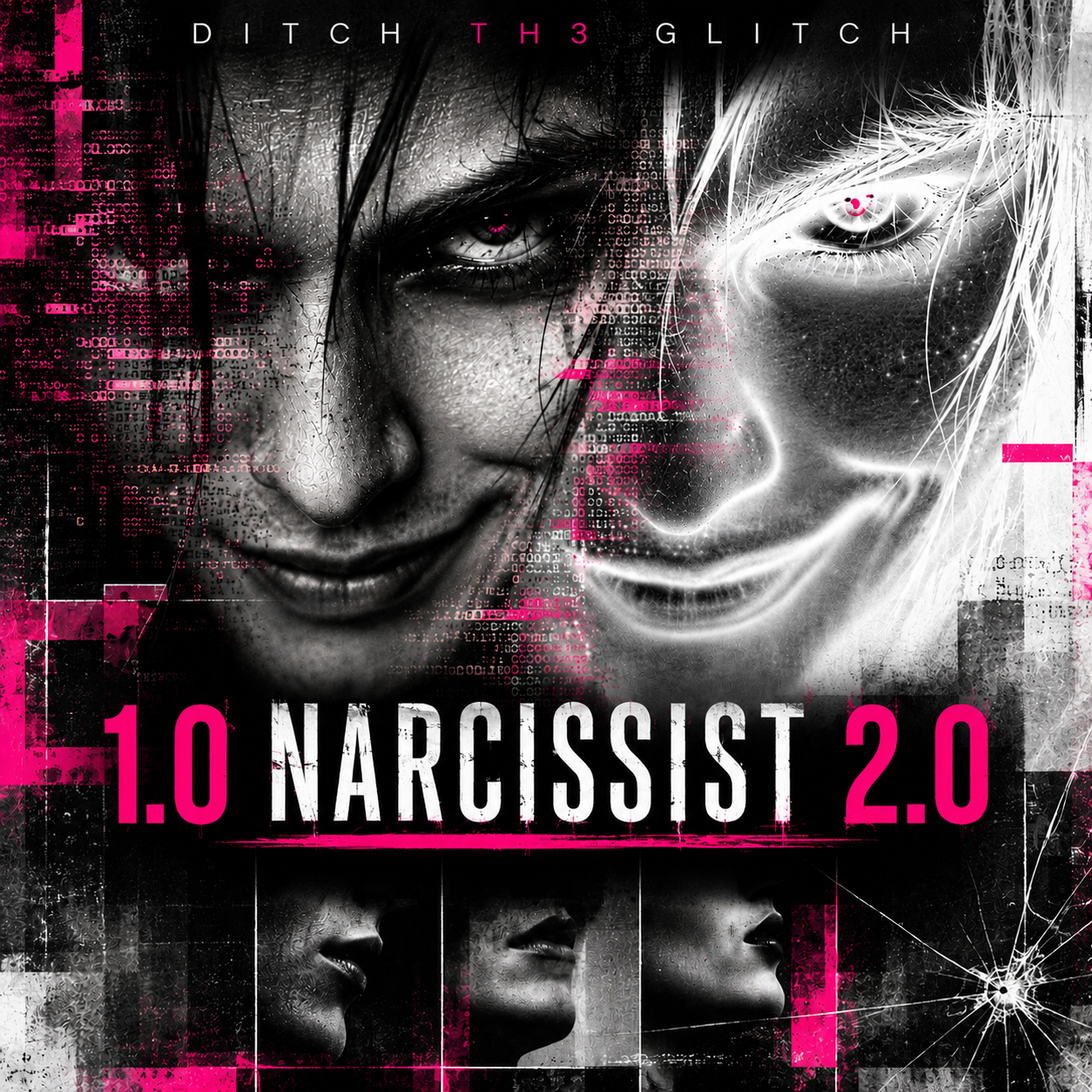
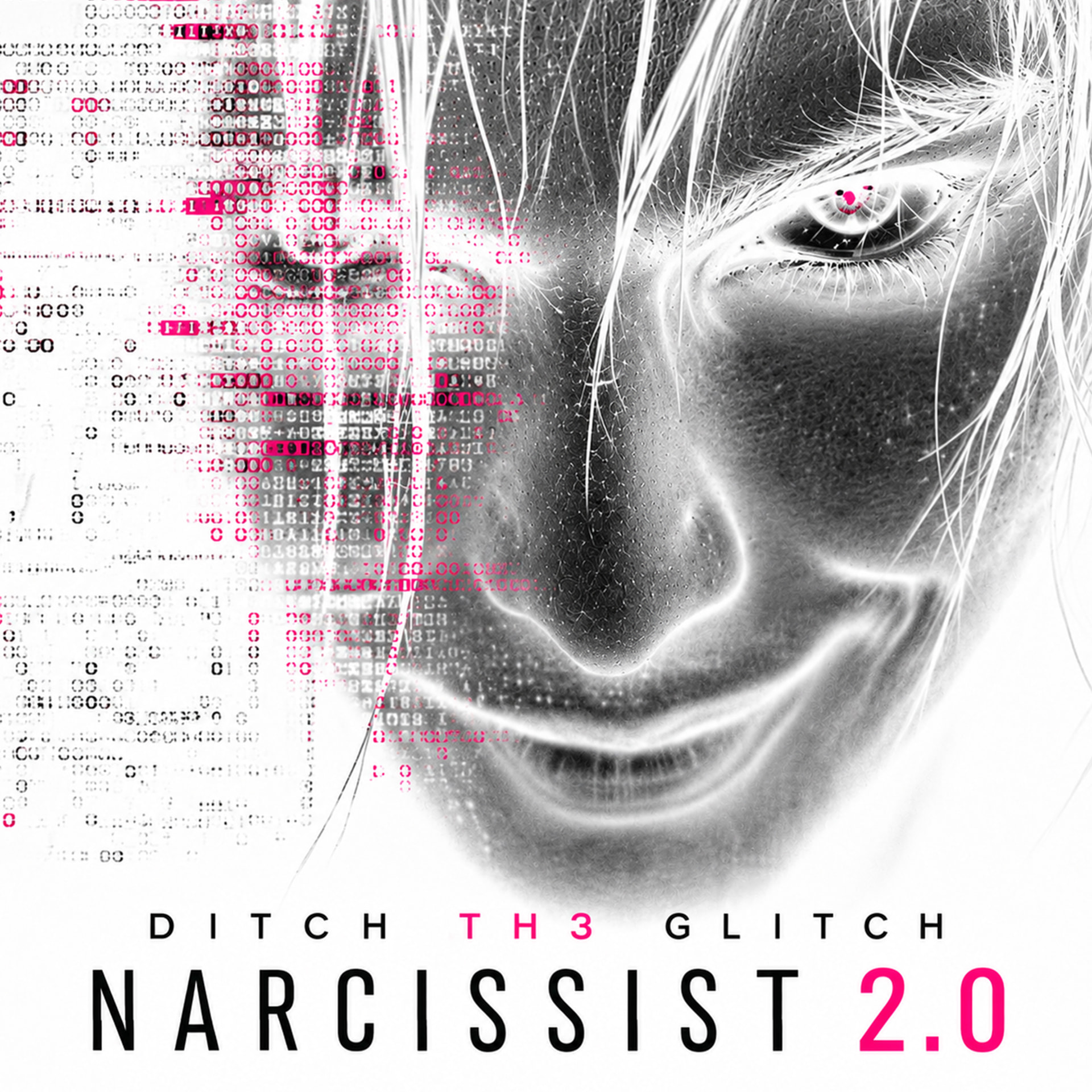
Narcissist 1.0 explored reflection and vanity. Narcissist 2.0 became a first-person portrait of manipulation and control. Gaslight 1.0 used direct denials and accusations. Gaslight 2.0 explored how uncertainty can be deliberately constructed. Bite Back 1.0 was an explosive declaration of revenge. Bite Back 2.0 became a response to the words, actions and psychological damage established by the other songs.
We didn't just make the tracks heavier or more polished. We gave them a shared history, and we learned how much more powerful lyrics can become when every word has a purpose.
THE FINAL WORD
After all those experiments, revisions, discarded versions and unexpected discoveries, Narcissist is finally finished. Well, almost. There's still one word we want to test.
MERGEA minor adjustment.
GLITCHYou said that last time.
DITCHJUST CHANGE THE FUCKING WORD.
Maybe that's the perfect ending to this journal. The whole process has been about learning when to keep pushing, when to step back and when to trust that one small change can make everything click. We started with three songs and ended up building a psychological narrative told through three voices. A manipulator, a system of manipulation and a voice that refuses to disappear.
NARCISSIST 2.0 DROPS DECEMBER 2026.